
Climate-Driven Loss Trends: Emerging Risks Multinationals Can’t Afford to Ignore
MWB Global Risks Industry Report: Market Intelligence for Improved Strategic Decisions

This document is for informational purposes only and is not intended to be exhaustive. No discussions or opinions in this document should be inferred as legal advice. Contact MWB Global Risks for insurance advice customized to your business needs. MWB Global Risks Inc. does not accept responsibility for the content of the information provided or any actions made on the basis of the information herein.
Please note: This article is a summary of MWB's Report on Digitization in the Industry. To download the full report, click below

Climate-Driven Loss Trends: Emerging Risks Multinationals Can’t Afford to Ignore
-------------------
Executive Summary
Climate-driven catastrophe losses are increasing in frequency, severity, and financial impact, creating a new reality for organizations around the world. While major catastrophes such as hurricanes, floods, and wildfires continue to generate significant losses, a growing share of damage is now being driven by smaller, more frequent events known as secondary perils. Severe convective storms, localized flooding, wildfires, drought, and extreme heat are producing substantial losses across regions that were not traditionally considered high-risk.
At the same time, economic development, urban expansion, and growing concentrations of high-value assets in hazard-prone areas are amplifying the financial consequences of these events. As a result, catastrophe losses are rising not only because natural hazards are becoming more severe, but also because more people, property, infrastructure, and economic activity are exposed when disasters occur.
This report examines the key trends reshaping the global catastrophe landscape, including the rise of secondary perils, the widening protection gap between insured and uninsured losses, the growing vulnerability of developed economies, increasing pressure on insurance markets, and the expanding impact of business interruption and supply chain disruption. Collectively, these factors suggest that climate-driven losses represent a structural shift rather than a temporary cycle.
For multinational organizations, the implications extend well beyond insurance purchasing. Climate risk is increasingly influencing site selection, capital allocation, supply chain management, operational resilience, and long-term strategic planning. Traditional approaches that rely primarily on historical loss data and reactive risk management practices may no longer be sufficient in an environment characterized by greater uncertainty and volatility.
Organizations that proactively integrate climate intelligence into enterprise risk management frameworks, reassess asset concentrations, strengthen supplier oversight, invest in mitigation measures, and evaluate the resilience of their insurance programs will be better positioned to manage future uncertainty.
As climate-driven losses continue to reshape the risk landscape, resilience is emerging not only as a risk management objective, but as a source of long-term competitive advantage.
Entering a New Era
Climate-related losses are evolving. While major catastrophes such as hurricanes, floods, and wildfires continue to generate significant losses, a growing share of insured losses is now being driven by smaller, more frequent events known as secondary perils.
For multinational organizations, this shift represents a new era of risk. Secondary perils can affect multiple regions simultaneously, disrupt supply chains, damage assets, and increase insurance costs even in areas not traditionally considered catastrophe-prone.
-----
The numbers tell a clear story: Catastrophe losses are rising at an alarming pace - and its only accelerating.
Global economic losses from natural catastrophes reached about $320 billion in 2024, with roughly $140 billion insured, far above long-term averages, underscoring the growing frequency and severity of extreme events worldwide.
While weather-related disasters accounted for 93% of all losses, underscoring the central role climate dynamics now play in global financial risk (Correspondent & Correspondent, 2025).
This trend has continued and is expected to continue at an accelerated pace. In the first half of 2025 alone, global insured losses hit roughly $100 billion, more than double the 21st-century average of $41 billion.
Overall economic losses climbed to $162 billion during the same period (World Economic Forum, 8 Aug 2025).
Reinsurers increasingly describe this as a structural shift rather than a temporary spike. Insured catastrophe losses have now exceeded $100 billion for five consecutive years, effectively establishing a “new normal” (Correspondent & Correspondent, 2025).
Secondary Perils are Becoming Primary Threats
Historically, insurers focused on major headline events such as hurricanes and earthquakes. Today, so-called “secondary perils” ( which typically include wildfires, flash floods, and severe thunderstorms) are driving much of the loss growth.
These perils have nearly doubled in insured loss over the past decade, according to industry data. Munich Re similarly reports that floods, severe convective storms, and wildfires produced losses exceeding long-term averages, with scientists broadly agreeing such disasters are becoming more severe and more frequent.
Example: California wildfires generated about $40 billion in insured losses in early 2025 - the largest wildfire loss ever recorded. Severe thunderstorms produced $31 billion in insured losses alone during the same period.
Why this matters: Secondary perils often occur with less warning, affect wider geographic areas, and may not be fully modeled in legacy insurance structures, ultimately creating unexpected coverage gaps and unexpected costs.

Exposure Growth is Amplifying the Data
Swiss Re notes that increased exposure in high-risk regions (particularly the wildland-urban interface) has been a major driver of fire losses, with growth in these zones significantly outpacing safer areas.
In other words, losses are rising not only because hazards are intensifying, but because businesses are expanding into vulnerable territories.
For multinationals, this has two strategic implications:
Site selection decisions now carry long-term insurance consequences.
Asset concentration can create correlated losses across facilities.
What once appeared to be efficient geographic clustering may now represent a systemic risk.
Geographic Justifications
If these areas present significant hazards and exposures, why aren’t organizations choosing to establish businesses in safer regions?
It isn’t because organizations seek more risk, it is a combination of several factors that make development in high-risk areas appealing - and sometimes unavoidable.
These factors could include:
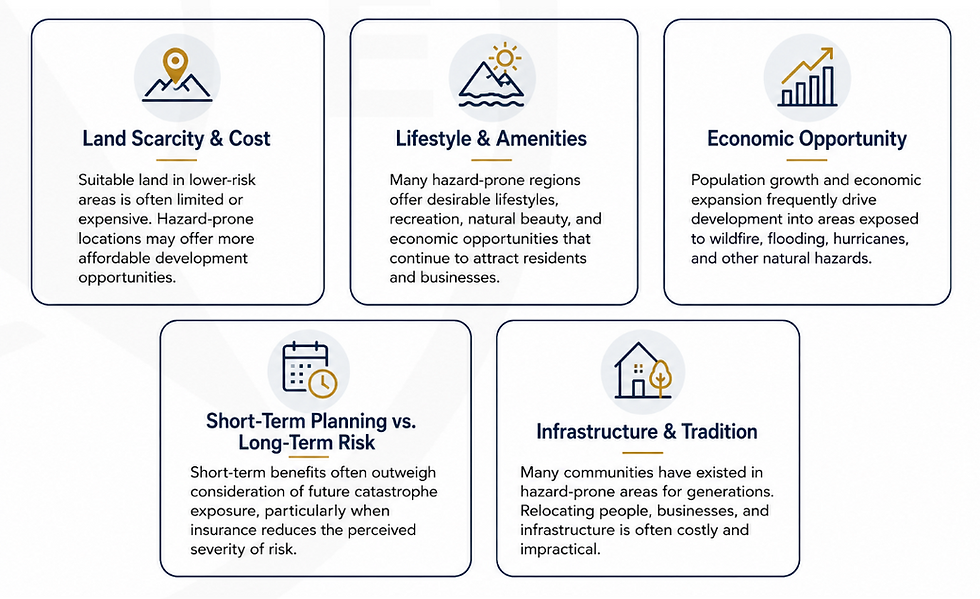
Thus, while relocating to safer areas is technically possible, a combination of economic, social, and cultural factors often outweighs the perceived risk. Land in hazard-prone regions is frequently more affordable or provides access to key resources, employment opportunities, scenic views, and recreational amenities.
Many communities also have deep historical, cultural, and familial ties to these areas, making relocation costly, disruptive, or undesirable.
In addition, disasters, while potentially catastrophic, often occur infrequently enough that individuals, businesses, and developers underestimate their likelihood or severity.
As a result, exposure in high-risk areas continues to increase. Insurers such as MWB Global Risks and Swiss Re have identified ongoing development in hazard-prone regions as a significant driver of catastrophe losses, concentrating valuable assets where natural hazards are most likely to occur and amplifying both financial and societal impacts.
Significant Gaps Persist
Despite rising insured losses, much disaster damage remains uninsured, sending ripple effects through the global economy.
Uninsured losses shift the financial burden from insurers to individuals, businesses, and governments, ultimately reducing economic resilience, slowing recovery after disasters, and increasing long-term costs for society.
Approximately 57% of disaster damages in 2024 were uninsured, leaving a protection gap of around $180 billion. Munich Re similarly estimates that about half of global losses remain uninsured in typical years.
For multinational organizations, this gap is particularly dangerous because it can hide within supply chains. A critical supplier lacking adequate coverage may be unable to recover after a disaster, disrupting production worldwide (2025, Munich Re, n.d.).
This is no theoretical risk: Research shows more than 87,000 Canadian businesses suffered financial losses from severe weather over the past decade alone (Insurance Bureau of Canada, 2024).
“A warming world makes extreme weather disasters more likely. Given that 2025 was another very warm year, the past 12 years have been the warmest on record. The warning signs persist. Indeed, under the prevailing circumstances climate change can worsen further.” -- Tobias Grimm, Chief Climatologist, Munich Re
Climate Risk is Intensifying in Developed Markets
Many executives still associate catastrophe risk primarily with emerging economies; however, in these times, that assumption could be costly.
Recent data show that developed economies are increasingly affected by severe weather and natural disasters, as well:
Since the 1980s, the number of severe weather events has climbed sharply and insured losses have doubled from $10 billion to $20 billion over the past five years (Insurance Bureau of Canada, 2024).
In fact, in 2024 alone:
Four severe weather events in Canada generated over $7 billion in insured losses and more than 250,000 claims.
Hurricanes Helene and Milton were among the costliest events of 2024, each causing insured losses of roughly $17.5 billion and $20 billion, respectively; ranking among the most expensive natural disaster events worldwide that year (Wilkinson, 2025).
Meanwhile, rising global temperatures are also a cause for concern. For example: Canada is warming roughly twice as fast as the global average, effectively increasing wildfire and extreme weather risks (Institut climatique du Canada, 2025).
Europe faces similar pressures: Extreme weather events are projected to cost the EU €43 billion, with losses expected to climb toward €126 billion by 2029 (Gilliver, 2025).
In short: Mature markets are not and will not be immune to these risks; in many cases, mature markets themselves are becoming hotspots for climate-driven losses.
Pricing Models are Struggling to Catch Up
Traditional actuarial approaches rely heavily on historical data. But when “hundred-year” events occur far more frequently, backward-looking models lose predictive power.
Industry leaders warn that pricing frameworks based on yesterday’s weather are proving inadequate as risk accelerates—and that insurers may be underpricing the exposure in some regions.
This mismatch can lead to several market reactions:
Higher premiums
Reduced capacity
Narrower terms
Withdrawal from high-risk areas
Indeed, some insurers have already scaled back coverage in vulnerable regions as climate disasters intensify.
For multinational buyers, the era of predictable renewals is fading.
Frequency is Rising...And so is Volatility
One of the most challenging aspects of climate-related risk is its inherent variability. Even in years without a major disaster, global insured losses can surpass historical averages due to clusters of mid-sized events such as tropical storms, regional floods, wildfires, or winter storms, all of which collectively generate significant economic impact.
These events underscore that it’s not just the “big one” that matters; the accumulation and accelerated frequency of smaller, more frequent events is reshaping risk landscapes worldwide.
Over the long term, insured losses have grown at an average rate of roughly 5.9% per year, outpacing global GDP growth (Sigma 1/2024, Swiss Re, 2025). If these trends continue, total insured losses could double within the next decade, which would put enormous pressure on both insurers as well as policyholders.
In effect, risk is expanding faster than the global economy itself which is challenging assumptions that losses will scale proportionally with economic growth.
For multinational organizations, this rising volatility has concrete implications. insurance (i.e.: buying coverage only after patterns emerge) can leave organizations exposed to significant financial shock.
Forward-looking risk management, including scenario modeling, stress testing, and flexible coverage structures, will be essential for navigating this new, unpredictable landscape.
“Amid annual volatility, insured losses keep rising. That’s why strengthening prevention, protection and preparedness is essential to protect lives and property.” – Jérôme Jean Haegeli, Group Chief Economist, Swiss Re Institute
Business Interruption is the Silent Multiplier
Physical damage is only part of the story. Climate events are increasingly generating indirect losses such as:
Supply chain disruption
Lost production
Workforce displacement
Infrastructure outages
European research highlights that economic estimates often include both direct damages and indirect costs like business interruption—yet still may underestimate long-term impacts.
For globally integrated companies, a single regional disaster can cascade into worldwide operational consequences.
Supply chain disruptions, production delays, and sudden spikes in costs can ripple across multiple countries, affecting revenue, customer commitments, and overall business resilience.
What This Means for an Organization’s Multinational Risk Strategy
Climate-driven losses are not simply an insurance issue, they are a governance issue and will require executive attention.
The organizations that treat climate risk as a strategic planning variable, and not merely an operational hazard, will be better positioned to maintain stability.
There is also a competitive angle that is often overlooked. Companies that proactively adapt may benefit from:
More stable insurance costs
Improved access to capacity
Stronger investor confidence
Reduced earnings volatility
Conversely, firms that lag behind could face higher total cost of risk and diminished operational flexibility.
Climate change is no longer an emerging concern; it is a defining force reshaping the insurance landscape.
As traditional playbooks are stretched and underwriting frameworks evolve, multinational organizations will be best positioned by treating program design not as a renewal exercise, but as a core component of enterprise risk strategy.
Organizations that would like to remain proactive should consider taking action now.
Here are 5 ways risk leaders can build resilience in a volatile world:

Looking Ahead: From Emerging Risk to Permanent Reality
The trajectory is unmistakable. Climate-driven disasters are no longer episodic shocks to the system—they are steadily reshaping the global loss environment and redefining what organizations must consider “normal.”
While individual loss years will fluctuate, the underlying drivers—rising temperatures, shifting weather patterns, urban expansion into hazard-prone regions, and increasingly interconnected supply chains—suggest a structural evolution rather than a temporary cycle.
Wildfires are burning longer and in regions historically considered low risk. Convective storms are producing larger insured losses with greater frequency. Flood events are occurring outside traditional floodplains, challenging long-held assumptions about geographic safety. At the same time, economic development continues to concentrate high-value assets in exposed areas, amplifying the financial consequences when events occur.
For multinational organizations, this convergence of hazard and exposure is elevating climate risk from an operational concern to a board-level priority. It is no longer sufficient to view catastrophic events as remote possibilities addressed primarily through insurance purchase. Instead, climate risk is becoming a central factor in capital allocation, site selection, supplier strategy, and long-term growth planning.
The critical question is no longer whether climate risk will disrupt operations, but how prepared an organization will be when disruption occurs - and how quickly it can recover.
Organizations that proactively integrate climate analytics into enterprise risk management frameworks are better positioned to anticipate loss drivers, negotiate from a position of strength in insurance markets, and reduce earnings volatility. Increasingly, resilience itself is becoming a source of competitive advantage.
Preparation, however, extends beyond modeling exposures. It requires rethinking traditional approaches to risk transfer, investing in physical mitigation where economically viable, and strengthening business continuity plans to reflect a world in which “secondary perils” can trigger primary financial consequences.
It also demands closer collaboration between risk management, finance, sustainability, and executive leadership—functions that historically operated in parallel but must now move in alignment.
Organizations that embed climate intelligence into strategic decision-making today are more likely to maintain operational stability, protect stakeholder confidence, and adapt as underwriting expectations evolve. Those that delay may find themselves reacting to tightening capacity, higher retentions, and coverage constraints—often after a loss has already exposed vulnerabilities.
To download the full article, please click below
Get the MWB Difference
Need Help?
Connect with MWB Global Risks to explore insurance and risk management solutions designed around the realities of your business.
MWB Global Risks is a boutique insurance and risk management brokerage specializing in domestic and multinational risk solutions for mid-sized to large organizations operating in increasingly complex environments.
Backed by 100+ years of combined industry experience, our team provides tailored guidance, technical expertise, and coordinated program execution across jurisdictions and industries.
Our approach is built on long-term relationships, responsive service, and a deep understanding of how insurance programs must perform both at placement and at the time of loss.
From multinational insurance structures to complex corporate risk strategies, we help organizations remain resilient, compliant, and prepared for growth in an evolving global landscape.

Any Risk. Anywhere in the World.
Insurance Expertise Above & Beyond
References:
Climate change is showing its claws: The world is getting hotter, resulting in severe hurricanes, thunderstorms and floods | Munich Re. (n.d.). https://www.munichre.com/en/company/media-relations/media-information-and-corporate-news/media-information/2025/natural-disaster-figures-2024.item-df873f6119f0560589587db3dcd8e798.html
Climate change presses on: Devastating wildfires and intense thunderstorms exacerbate losses for insurers | Munich Re. (n.d.). https://www.munichre.com/en/company/media-relations/media-information-and-corporate-news/media-information/2026/natural-disaster-figures-2025.html
Climate events have cost $162b in 2025. Insurance covered most. (2026, January 5). World Economic Forum. https://www.weforum.org/stories/2025/08/global-insurance-industry-gap/
Correspondent, I., & Correspondent, I. (2025, September 18). Insurers face climate crisis head-on. International Finance. https://internationalfinance.com/magazine/insurers-face-climate-crisis-head-on
Garric, A. (2025, September 15). Summer 2025 heat waves cost France over €10 billion. Le Monde.fr. https://www.lemonde.fr/en/environment/article/2025/09/15/summer-2025-heat-waves-cost-france-over-10-billion_6745420_114.html
Gilliver, L. (2025, October 9). Cost of Europe’s extreme weather doubled this decade - and could hit €126 billion by 2029. Euronews. https://www.euronews.com/green/2025/10/09/cost-of-europes-extreme-weather-doubled-this-decade-and-could-hit-126-billion-by-2029
Institut climatique du Canada. (2025, July 7). Climate change and extreme heat waves in Canada. Canadian Climate Institute. https://climateinstitute.ca/news/fact-sheet-heat-waves

Comments